stock market course

best stock market course
Blog, stock market course

Best Stock Market Course for Beginners to Advanced Traders

Are you searching for the best stock market course to kickstart your trading journey? Whether you are a complete beginner who has never bought a single share, or an experienced trader looking to upgrade your skills with algorithmic strategies, choosing the right education platform makes all the difference. India’s financial markets are booming. The NSE and BSE together handle millions of retail trades every single day. Yet, most traders still lose money — not because the market is unfair, but because they lack proper structured learning. Enrolling in the best stock market course gives you the edge that separates profitable traders from the rest. In this comprehensive guide, we will walk you through everything you need to know about selecting the best course to learn stock market fundamentals, derivatives, commodities, forex, crypto, and algorithmic trading. By the end of this post, you will have a clear roadmap to choose the right program and start trading with confidence. Why You Need the Best Stock Market Course in 2025 Many people try to learn trading from YouTube videos, random blog posts, or tips from friends. While free content has its place, nothing replaces a structured, expert-led curriculum. Here is why investing in the best stock market course is a smart decision: Structured Learning Path: A good course takes you from zero to proficient without overwhelming you. You progress step by step — from understanding stock exchanges to executing live trades. Expert Mentorship: The best course of stock market training is delivered by professionals who have actually traded in real markets. Their real-world insights save you years of trial and error. Risk Management Training: Every profitable trader will tell you that managing risk is more important than picking winners. The best course for stock market for beginners teaches position sizing, stop-losses, and capital allocation from day one. Live Market Practice: Theory alone cannot make you a trader. The best programs include paper trading, live sessions, and real-time market analysis so that you develop practical skills alongside theoretical knowledge. Community and Support: When you join the best stock market course, you also join a community of like-minded traders. Peer learning, group discussions, and mentor support accelerate your progress dramatically. What to Look for in the Best Course for Indian Stock Market India’s stock market has its own unique characteristics. SEBI regulations, NSE/BSE dynamics, F&O settlement cycles, commodity exchanges like MCX — these are topics that only a platform focused on the best course for Indian stock market will cover comprehensively. Here are the key factors to evaluate before enrolling: 1. Curriculum Depth and Breadth The best course to learn about stock market should cover: Equity Basics — How stock markets work, IPOs, indices (Nifty 50, Sensex), demat accounts, and order types Technical Analysis — Candlestick patterns, support & resistance, RSI, MACD, EMA, Bollinger Bands, volume analysis Fundamental Analysis — Reading balance sheets, P&L statements, ratios like P/E, P/B, ROE, and sector analysis Futures & Options (F&O) — Contract mechanics, payoff structures, Greeks (Delta, Theta, Vega), hedging strategies Commodities — Gold, silver, crude oil, agricultural commodities on MCX Forex & Crypto — Currency pairs, global macro factors, cryptocurrency market structure Algorithmic Trading — API integration, no-code bots, backtesting, and live deployment 2. Instructor Credentials The best course for learning stock market strategies should be taught by someone who has skin in the game — a SEBI-registered research analyst, a professional quant trader, or a seasoned portfolio manager with a verifiable track record. 3. Mode of Delivery Look for a course that offers: Pre-recorded video lessons for self-paced learning Live interactive webinars for real-time market discussions Downloadable study material and trading worksheets WhatsApp or Telegram support groups 4. Post-Course Support The best stock market course does not end when the last lesson is over. Lifetime access to course updates, ongoing mentorship, and a supportive community are signs of a genuinely valuable program. 5. Pricing and Value The best course for stock market for beginners should be accessible. Avoid platforms that charge lakhs for basic content. Look for transparent pricing, no hidden costs, and a clear money-back or satisfaction policy. Best Stock Market Course Options at API Trader API Trader is a Mumbai-based AI and algorithmic trading education company that has designed six specialized courses for Indian traders at every skill level. Let us look at each program in detail. Stock Market Basic Fundamental Program — ₹9,999 This is the best stock market course for absolute beginners. It covers the A to Z of stock markets, company analysis, and safe long-term investing. Over 12 structured lessons, you will learn: How Indian stock exchanges (NSE/BSE) operate How to open and manage a demat and trading account Understanding Nifty, Sensex, and sector indices Basics of technical and fundamental analysis How to pick strong stocks for long-term wealth creation If you are looking for the best course for stock market for beginners that builds unshakeable foundations, this program is your starting point. At just ₹9,999 with lifetime access, it offers exceptional value. F&O Trading Sikandar Program — ₹19,999 Futures and Options are where serious traders generate significant returns — but also where the uninformed lose money fast. The F&O Trading Sikandar Program is the best course to learn stock market derivatives trading in India. This 15-lesson course covers: Understanding Futures contracts — lot sizes, margin requirements, rollover Options basics — Calls, Puts, strike prices, expiry Option Greeks — Delta, Gamma, Theta, Vega in plain language Advanced strategies — Iron Condor, Bull Call Spread, Bear Put Spread Risk management and position sizing for F&O Live market setup and trade execution With 120+ enrolled students already profiting from this curriculum, this is widely considered the best course of stock market derivatives training for intermediate traders. Forex & Crypto Trading Sikandar Program — ₹19,999 Global markets never sleep. The Forex & Crypto Trading Sikandar Program is the best stock market course for traders who want to expand beyond Indian equities and trade currency pairs and digital assets. This 18-lesson program teaches: Major

best stock market course
stock market course

Best Stock Market Course for Beginners in India

Introduction Are you a beginner who wants to start investing but feels lost every time you open a trading app? You are not alone. Millions of Indians every year search for the best stock market course to help them understand how to put their hard-earned money to work in the equity markets. The Indian stock market is one of the fastest-growing financial markets in the world, with Nifty 50 consistently delivering strong long-term returns. Yet most beginners enter without any proper education, lose money, and quit forever. The good news? That story does not have to be yours. With the right education, the right mentor, and the best course for stock market for beginners, you can learn to read charts, understand companies, manage risk, and even automate your trades using algorithmic strategies. In this comprehensive guide, we break down everything you need to know before enrolling in a stock market course in India — including what to look for, what topics you must learn, and why API Trader stands out as the destination for serious learners. Let’s begin. Why Every Indian Beginner Needs a Proper Stock Market Education India’s retail investor base has exploded over the last five years. According to SEBI data, the number of demat accounts crossed 16 crore in 2024. Yet the majority of new traders are completely self-taught, relying on random YouTube videos, WhatsApp tips, and social media stock gurus. The result? Most beginners lose money in their first year. A structured course changes everything. When you enroll in the best stock market course, you learn in a logical sequence — starting with fundamentals, progressing to technical analysis, and eventually mastering strategies that professional traders use. You stop gambling and start investing with purpose. Here is why structured learning beats self-study: Sequence matters. You learn what a P/E ratio means before you apply it to screen stocks. You understand candlestick patterns before you read a live chart. Mentorship accelerates growth. Real experts point out your mistakes before they cost you money. Community keeps you accountable. Peers at the same stage motivate you and share insights. Practice environments reduce real risk. Many good courses offer paper trading or simulated environments. The best course to learn stock market investing is not just a collection of videos. It is a transformation in how you think about money, markets, and financial freedom. What Topics Should the Best Course for Indian Stock Market Cover? Before you spend a single rupee on any program, check that it covers these essential areas. A truly comprehensive best course for Indian stock market education should include the following modules. 1. Stock Market Fundamentals This is the foundation. A beginner must understand: What is the stock market and how does it work? Difference between BSE and NSE What are shares, indices, and market capitalisation? How are stocks bought and sold through a broker? What is a demat account and how to open one? Role of SEBI in regulating Indian markets Without this foundation, everything else will confuse you. 2. Fundamental Analysis Fundamental analysis is about understanding the health of a company. It answers the question: “Is this company worth investing in long-term?” Topics include: Reading balance sheets, income statements, and cash flow statements Understanding P/E ratio, P/B ratio, EPS, ROE, and ROCE Comparing companies within the same sector Understanding the business model and competitive advantage Identifying promoter holding and institutional interest The best course for learning stock market investing will dedicate significant time to fundamental analysis, because it is the backbone of long-term wealth creation. 3. Technical Analysis While fundamental analysis tells you what to buy, technical analysis tells you when to buy. Key topics include: Candlestick patterns (Doji, Hammer, Engulfing, Morning Star, etc.) Support and resistance levels Moving averages (SMA, EMA) RSI, MACD, Bollinger Bands, and other indicators Chart patterns like Head and Shoulders, Double Top, Flags Volume analysis Indian retail traders predominantly use technical analysis for short-term trading. Any best stock market course that skips technical analysis is incomplete. 4. F&O — Futures and Options Futures and Options are derivative instruments that can be used for speculation, hedging, or income generation. This is an advanced but extremely important topic for Indian traders because F&O volumes on NSE are among the highest in the world. Topics to cover: What are futures and options? Call and Put options explained simply Option Greeks: Delta, Theta, Gamma, Vega Option buying vs option selling strategies Hedging strategies for portfolio protection SEBI F&O rules and margin requirements 5. Algo and Automated Trading This is where the Indian market is headed. Algorithmic trading, once reserved for institutional players, is now accessible to retail traders through platforms like API Trader. A forward-looking best course to learn about stock market trading should include: What is algorithmic trading and how does it work? Building a simple algo strategy using Python or no-code tools Backtesting strategies on historical data Connecting broker APIs for automated execution Risk management in automated trading systems API Trader specialises in this area, offering India’s most accessible No-Code Algo program for retail traders. 6. Risk Management and Psychology This is the most underrated topic in most courses. Professional traders know that managing risk is more important than picking the right stock. Position sizing Stop-loss strategies Portfolio diversification Avoiding revenge trading and FOMO Building a trading plan and following it consistently No best course for stock market for beginners is complete without a deep module on trading psychology. Types of Stock Market Courses Available in India The Indian market for stock market education has exploded. Here’s a breakdown of the types of programs available: Free Online Resources YouTube channels, SEBI’s investor education portal, and Zerodha’s Varsity offer free educational content. These are excellent starting points but lack structure, mentorship, and depth. University and College Programs Some universities now offer finance electives that include stock market basics. These are theoretical and rarely include practical trading exposure. Certification Courses (NCFM, NISM) SEBI mandates NISM certifications for stockbrokers and advisors. These are excellent for

stock trading courses in India
Blog, stock market course

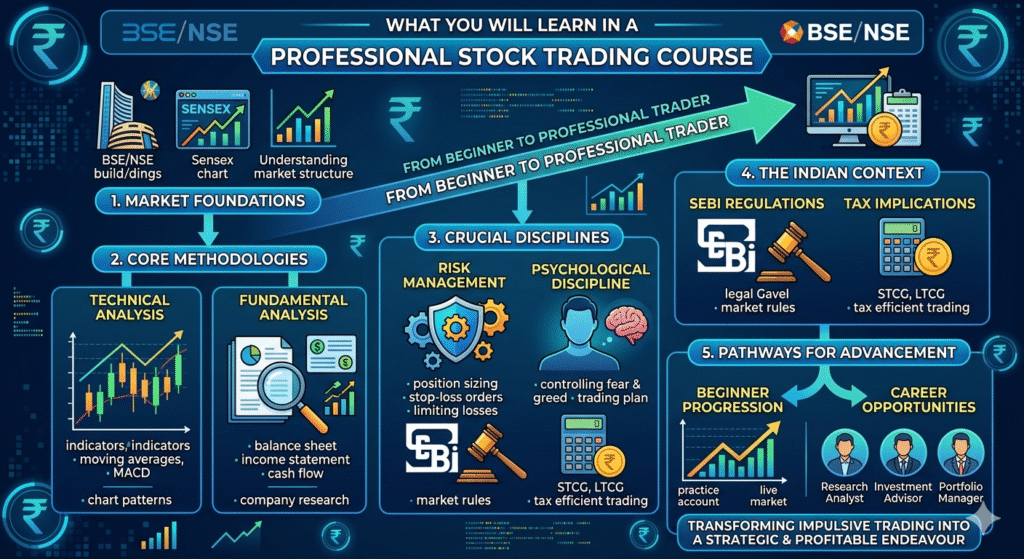
What You Will Learn in a Professional Stock Trading Course

The Indian stock market has never been more accessible. With over 13 crore registered demat accounts and millions of retail investors entering the market each year, the demand to learn stock market trading has surged like never before. Yet, the gap between entering the market and trading profitably remains enormous — and that gap is filled by one thing: structured education. Enrolling in professional stock trading courses can be the single most important investment you make before risking a single rupee in the markets. Whether you are a college student curious about equities, a working professional looking to build a second income stream, or a retiree exploring passive wealth creation, the right course transforms confusion into clarity, impulse trades into calculated decisions, and losses into learning opportunities. This comprehensive guide walks you through everything you will learn in a professional stock trading course — from the foundations of market structure to the nuances of algorithmic trading — and why choosing the right program matters more than most beginners realize. What Are Stock Trading Courses? Stock trading courses are structured educational programs designed to teach individuals how to buy, sell, and manage positions in financial securities including stocks, derivatives, ETFs, and other market instruments. These programs vary widely in scope and depth — from short weekend workshops to multi-month certification programs — but the best ones combine theoretical knowledge with practical application. Unlike self-taught approaches that often rely on fragmented YouTube tutorials or unverified social media tips, professional stock trading courses follow a curated curriculum built around proven trading methodologies, real market scenarios, and mentored practice. They teach you not just what to do, but why a specific strategy works under specific market conditions. At their core, these courses are designed to: Build a deep understanding of how financial markets operate Develop skills in both technical and fundamental analysis Instil disciplined risk management habits Train traders to control emotions during volatile market conditions Prepare learners for certifications like NISM Series VIII or NSE Academy programs Whether delivered in a classroom or online, stock trading courses for beginners and experienced traders alike follow a logic-driven progression that ensures you are never overwhelmed — but always growing. Why Enroll in Stock Trading Courses in India? India’s financial markets — the Bombay Stock Exchange (BSE) and National Stock Exchange (NSE) — rank among the most dynamic in the world. The NSE alone records average daily turnover in excess of ₹20,000 crore in the cash segment. Yet, studies consistently show that 70–90% of retail traders lose money in the long run. The reason is rarely lack of intelligence. It is almost always lack of education. Stock trading courses in India address this critical gap. Here is why they are essential in the Indian context: India-Specific Market Nuances The Indian market operates under SEBI regulations, follows unique circuit breaker rules, and has specific settlement cycles (T+1 rolling settlement). The best stock trading courses in India incorporate these nuances rather than teaching generic global frameworks. Tax Implications Under Indian Law Short-term capital gains (STCG) tax, long-term capital gains (LTCG) tax, Securities Transaction Tax (STT), and GST on brokerage — these are India-specific financial considerations that directly affect your net profitability. Professional courses teach you how to trade tax-efficiently. Access to Indian Indices and Instruments Learning about NIFTY 50, SENSEX, Bank NIFTY, and sectoral indices, along with India-specific instruments like Sovereign Gold Bonds and REITs, is essential for traders operating in this market. Regulatory Awareness SEBI guidelines on margin requirements, insider trading restrictions, and algo trading regulations must be understood by every serious trader. Stock trading courses in India ensure you operate within legal and ethical boundaries. Growing Retail Participation With platforms like Zerodha, Upstox, and Angel One onboarding millions of first-time traders every year, the need for online trading for beginners has never been greater. Education is the foundation of sustainable participation. Core Subjects Covered in Stock Trading Courses A professional stock trading course typically covers the following core subjects in a structured, progressive manner. Understanding these modules helps you evaluate which program gives you the most comprehensive foundation. Understanding Financial Markets and Their Structure Every professional program begins here. Before you place your first trade, you need to understand the ecosystem you are entering. This module covers: How stock exchanges work: Order books, market makers, clearing corporations (NSCCL, ICCL), and settlement processes Types of financial markets: Primary market (IPOs, FPOs) vs. secondary market (exchange-traded equities) Asset classes: Equities, debt instruments, derivatives, commodities, currencies, and mutual funds Market participants: Retail traders, institutional investors, Foreign Institutional Investors (FIIs), Domestic Institutional Investors (DIIs), and High-Frequency Trading (HFT) firms SEBI’s role: Regulatory framework, investor protection mechanisms, and market surveillance Understanding market structure gives you perspective. You realize that every time you click “Buy,” there is a seller on the other side — and understanding who that seller is and why they are selling can mean the difference between profit and loss. Technical Analysis: Reading Charts Like a Pro Technical analysis is the heartbeat of most stock trading courses. It is the art and science of reading price charts to predict future price movements based on historical patterns, volume data, and mathematical indicators. Key topics covered include: Chart Types and Timeframes Candlestick charts, bar charts, and line charts Reading timeframes: 1-minute, 5-minute, 15-minute, hourly, daily, weekly charts Identifying trends: uptrend, downtrend, and sideways consolidation Candlestick Patterns Single candlestick patterns: Doji, Hammer, Shooting Star, Marubozu Multi-candlestick patterns: Engulfing, Morning Star, Evening Star, Harami Reliability ratings and confirmation strategies Support and Resistance Drawing horizontal support and resistance levels Dynamic support/resistance using moving averages Role reversals and breakout confirmation Chart Patterns Continuation patterns: Flags, Pennants, Triangles, Wedges Reversal patterns: Head and Shoulders, Double Top, Double Bottom, Rounding Bottom Volume confirmation for pattern validation Technical Indicators Trend indicators: Moving Averages (SMA, EMA), MACD (Moving Average Convergence Divergence), ADX (Average Directional Index) Momentum oscillators: RSI (Relative Strength Index), Stochastic Oscillator, CCI (Commodity Channel Index) Volume indicators: OBV (On-Balance Volume), VWAP (Volume-Weighted Average Price), MFI (Money