Author name: Letsmakebrand Letsmakebrand

best stock market course
Blog, stock market course

Best Stock Market Course for Beginners to Advanced Traders

Are you searching for the best stock market course to kickstart your trading journey? Whether you are a complete beginner who has never bought a single share, or an experienced trader looking to upgrade your skills with algorithmic strategies, choosing the right education platform makes all the difference. India’s financial markets are booming. The NSE and BSE together handle millions of retail trades every single day. Yet, most traders still lose money — not because the market is unfair, but because they lack proper structured learning. Enrolling in the best stock market course gives you the edge that separates profitable traders from the rest. In this comprehensive guide, we will walk you through everything you need to know about selecting the best course to learn stock market fundamentals, derivatives, commodities, forex, crypto, and algorithmic trading. By the end of this post, you will have a clear roadmap to choose the right program and start trading with confidence. Why You Need the Best Stock Market Course in 2025 Many people try to learn trading from YouTube videos, random blog posts, or tips from friends. While free content has its place, nothing replaces a structured, expert-led curriculum. Here is why investing in the best stock market course is a smart decision: Structured Learning Path: A good course takes you from zero to proficient without overwhelming you. You progress step by step — from understanding stock exchanges to executing live trades. Expert Mentorship: The best course of stock market training is delivered by professionals who have actually traded in real markets. Their real-world insights save you years of trial and error. Risk Management Training: Every profitable trader will tell you that managing risk is more important than picking winners. The best course for stock market for beginners teaches position sizing, stop-losses, and capital allocation from day one. Live Market Practice: Theory alone cannot make you a trader. The best programs include paper trading, live sessions, and real-time market analysis so that you develop practical skills alongside theoretical knowledge. Community and Support: When you join the best stock market course, you also join a community of like-minded traders. Peer learning, group discussions, and mentor support accelerate your progress dramatically. What to Look for in the Best Course for Indian Stock Market India’s stock market has its own unique characteristics. SEBI regulations, NSE/BSE dynamics, F&O settlement cycles, commodity exchanges like MCX — these are topics that only a platform focused on the best course for Indian stock market will cover comprehensively. Here are the key factors to evaluate before enrolling: 1. Curriculum Depth and Breadth The best course to learn about stock market should cover: Equity Basics — How stock markets work, IPOs, indices (Nifty 50, Sensex), demat accounts, and order types Technical Analysis — Candlestick patterns, support & resistance, RSI, MACD, EMA, Bollinger Bands, volume analysis Fundamental Analysis — Reading balance sheets, P&L statements, ratios like P/E, P/B, ROE, and sector analysis Futures & Options (F&O) — Contract mechanics, payoff structures, Greeks (Delta, Theta, Vega), hedging strategies Commodities — Gold, silver, crude oil, agricultural commodities on MCX Forex & Crypto — Currency pairs, global macro factors, cryptocurrency market structure Algorithmic Trading — API integration, no-code bots, backtesting, and live deployment 2. Instructor Credentials The best course for learning stock market strategies should be taught by someone who has skin in the game — a SEBI-registered research analyst, a professional quant trader, or a seasoned portfolio manager with a verifiable track record. 3. Mode of Delivery Look for a course that offers: Pre-recorded video lessons for self-paced learning Live interactive webinars for real-time market discussions Downloadable study material and trading worksheets WhatsApp or Telegram support groups 4. Post-Course Support The best stock market course does not end when the last lesson is over. Lifetime access to course updates, ongoing mentorship, and a supportive community are signs of a genuinely valuable program. 5. Pricing and Value The best course for stock market for beginners should be accessible. Avoid platforms that charge lakhs for basic content. Look for transparent pricing, no hidden costs, and a clear money-back or satisfaction policy. Best Stock Market Course Options at API Trader API Trader is a Mumbai-based AI and algorithmic trading education company that has designed six specialized courses for Indian traders at every skill level. Let us look at each program in detail. Stock Market Basic Fundamental Program — ₹9,999 This is the best stock market course for absolute beginners. It covers the A to Z of stock markets, company analysis, and safe long-term investing. Over 12 structured lessons, you will learn: How Indian stock exchanges (NSE/BSE) operate How to open and manage a demat and trading account Understanding Nifty, Sensex, and sector indices Basics of technical and fundamental analysis How to pick strong stocks for long-term wealth creation If you are looking for the best course for stock market for beginners that builds unshakeable foundations, this program is your starting point. At just ₹9,999 with lifetime access, it offers exceptional value. F&O Trading Sikandar Program — ₹19,999 Futures and Options are where serious traders generate significant returns — but also where the uninformed lose money fast. The F&O Trading Sikandar Program is the best course to learn stock market derivatives trading in India. This 15-lesson course covers: Understanding Futures contracts — lot sizes, margin requirements, rollover Options basics — Calls, Puts, strike prices, expiry Option Greeks — Delta, Gamma, Theta, Vega in plain language Advanced strategies — Iron Condor, Bull Call Spread, Bear Put Spread Risk management and position sizing for F&O Live market setup and trade execution With 120+ enrolled students already profiting from this curriculum, this is widely considered the best course of stock market derivatives training for intermediate traders. Forex & Crypto Trading Sikandar Program — ₹19,999 Global markets never sleep. The Forex & Crypto Trading Sikandar Program is the best stock market course for traders who want to expand beyond Indian equities and trade currency pairs and digital assets. This 18-lesson program teaches: Major

best stock market course
stock market course

Best Stock Market Course for Beginners in India

Introduction Are you a beginner who wants to start investing but feels lost every time you open a trading app? You are not alone. Millions of Indians every year search for the best stock market course to help them understand how to put their hard-earned money to work in the equity markets. The Indian stock market is one of the fastest-growing financial markets in the world, with Nifty 50 consistently delivering strong long-term returns. Yet most beginners enter without any proper education, lose money, and quit forever. The good news? That story does not have to be yours. With the right education, the right mentor, and the best course for stock market for beginners, you can learn to read charts, understand companies, manage risk, and even automate your trades using algorithmic strategies. In this comprehensive guide, we break down everything you need to know before enrolling in a stock market course in India — including what to look for, what topics you must learn, and why API Trader stands out as the destination for serious learners. Let’s begin. Why Every Indian Beginner Needs a Proper Stock Market Education India’s retail investor base has exploded over the last five years. According to SEBI data, the number of demat accounts crossed 16 crore in 2024. Yet the majority of new traders are completely self-taught, relying on random YouTube videos, WhatsApp tips, and social media stock gurus. The result? Most beginners lose money in their first year. A structured course changes everything. When you enroll in the best stock market course, you learn in a logical sequence — starting with fundamentals, progressing to technical analysis, and eventually mastering strategies that professional traders use. You stop gambling and start investing with purpose. Here is why structured learning beats self-study: Sequence matters. You learn what a P/E ratio means before you apply it to screen stocks. You understand candlestick patterns before you read a live chart. Mentorship accelerates growth. Real experts point out your mistakes before they cost you money. Community keeps you accountable. Peers at the same stage motivate you and share insights. Practice environments reduce real risk. Many good courses offer paper trading or simulated environments. The best course to learn stock market investing is not just a collection of videos. It is a transformation in how you think about money, markets, and financial freedom. What Topics Should the Best Course for Indian Stock Market Cover? Before you spend a single rupee on any program, check that it covers these essential areas. A truly comprehensive best course for Indian stock market education should include the following modules. 1. Stock Market Fundamentals This is the foundation. A beginner must understand: What is the stock market and how does it work? Difference between BSE and NSE What are shares, indices, and market capitalisation? How are stocks bought and sold through a broker? What is a demat account and how to open one? Role of SEBI in regulating Indian markets Without this foundation, everything else will confuse you. 2. Fundamental Analysis Fundamental analysis is about understanding the health of a company. It answers the question: “Is this company worth investing in long-term?” Topics include: Reading balance sheets, income statements, and cash flow statements Understanding P/E ratio, P/B ratio, EPS, ROE, and ROCE Comparing companies within the same sector Understanding the business model and competitive advantage Identifying promoter holding and institutional interest The best course for learning stock market investing will dedicate significant time to fundamental analysis, because it is the backbone of long-term wealth creation. 3. Technical Analysis While fundamental analysis tells you what to buy, technical analysis tells you when to buy. Key topics include: Candlestick patterns (Doji, Hammer, Engulfing, Morning Star, etc.) Support and resistance levels Moving averages (SMA, EMA) RSI, MACD, Bollinger Bands, and other indicators Chart patterns like Head and Shoulders, Double Top, Flags Volume analysis Indian retail traders predominantly use technical analysis for short-term trading. Any best stock market course that skips technical analysis is incomplete. 4. F&O — Futures and Options Futures and Options are derivative instruments that can be used for speculation, hedging, or income generation. This is an advanced but extremely important topic for Indian traders because F&O volumes on NSE are among the highest in the world. Topics to cover: What are futures and options? Call and Put options explained simply Option Greeks: Delta, Theta, Gamma, Vega Option buying vs option selling strategies Hedging strategies for portfolio protection SEBI F&O rules and margin requirements 5. Algo and Automated Trading This is where the Indian market is headed. Algorithmic trading, once reserved for institutional players, is now accessible to retail traders through platforms like API Trader. A forward-looking best course to learn about stock market trading should include: What is algorithmic trading and how does it work? Building a simple algo strategy using Python or no-code tools Backtesting strategies on historical data Connecting broker APIs for automated execution Risk management in automated trading systems API Trader specialises in this area, offering India’s most accessible No-Code Algo program for retail traders. 6. Risk Management and Psychology This is the most underrated topic in most courses. Professional traders know that managing risk is more important than picking the right stock. Position sizing Stop-loss strategies Portfolio diversification Avoiding revenge trading and FOMO Building a trading plan and following it consistently No best course for stock market for beginners is complete without a deep module on trading psychology. Types of Stock Market Courses Available in India The Indian market for stock market education has exploded. Here’s a breakdown of the types of programs available: Free Online Resources YouTube channels, SEBI’s investor education portal, and Zerodha’s Varsity offer free educational content. These are excellent starting points but lack structure, mentorship, and depth. University and College Programs Some universities now offer finance electives that include stock market basics. These are theoretical and rarely include practical trading exposure. Certification Courses (NCFM, NISM) SEBI mandates NISM certifications for stockbrokers and advisors. These are excellent for

equity trading course for beginners
Blog, Equity trading course

Best Equity Trading Course for Beginners 2026

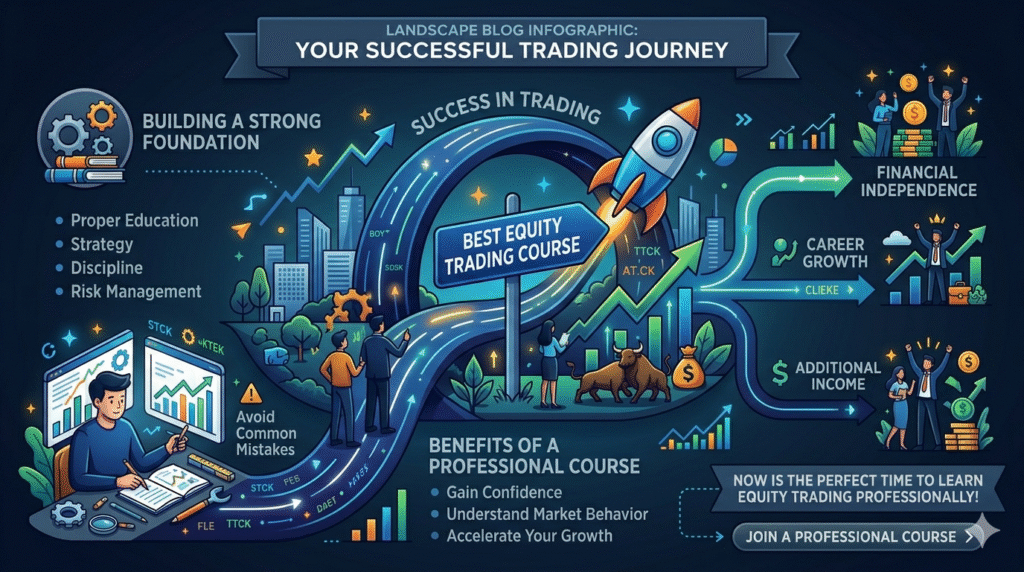
Are you ready to take your first step into the world of the stock market? If you have been searching for the best equity trading course for beginners in 2026, you are already making one of the smartest financial decisions of your life. Equity trading is no longer reserved for Wall Street professionals or seasoned investors. Today, with the right guidance, anyone can learn equity trading, build wealth, and create a steady income stream — all from the comfort of their home. The Indian stock market has grown exponentially over the last decade. With over 9 crore active Demat accounts and millions of new investors entering the markets every year, there has never been a better time to enroll in an equity trading course and start your investment journey. Whether you dream of trading full-time or simply want to grow your savings intelligently, the right equity trading course for beginners can change your financial future forever. In this comprehensive guide, we will walk you through everything you need to know — from understanding what equity trading is, why it matters in 2026, what to look for in a course, and why API Trader’s Stock Market Basic Fundamental Program stands out as the best equity trading course available today. What Is Equity Trading and Why Should Beginners Learn It? Equity trading refers to the buying and selling of company shares (also called stocks or equities) on a stock exchange like the NSE (National Stock Exchange) or BSE (Bombay Stock Exchange). When you purchase shares of a company, you become a partial owner of that business. The value of your investment rises or falls based on the company’s performance and market sentiment. Learning equity trading opens up a world of financial opportunity. Here is why every beginner should consider it: Wealth Creation: Over the long term, equities have consistently outperformed all other asset classes including gold, real estate, and fixed deposits. Passive Income Opportunities: Through dividends and capital gains, equity traders can earn income without active daily effort. Financial Independence: Understanding the markets empowers you to make informed decisions instead of relying on tips from friends or brokers. Career Opportunities: Skilled traders and analysts are in high demand across brokerages, hedge funds, and financial advisory firms. Low Entry Barrier: Unlike real estate, you can begin equity trading with as little as ₹500 to ₹1,000. However, equity trading without proper education can be risky. That is why enrolling in a structured equity trading course for beginners is not just recommended — it is essential. What to Look for in the Best Equity Trading Course for Beginners Not all courses are created equal. With hundreds of online and offline programs claiming to teach you stock market mastery, how do you choose the right one? Here are the key qualities that define the best equity trading course for beginners in 2026: 1. Structured Curriculum Starting from Basics A beginner-friendly course must start from ground zero. It should explain fundamental concepts like what a stock is, how the stock exchange functions, types of orders, and basic market terminologies — before moving to advanced topics like technical analysis or derivatives. 2. Expert and Experienced Instructors Your learning quality depends on who is teaching you. Look for instructors who are active traders with real market experience, not just theory teachers. Mentors who have traded in live markets understand market psychology, risk management, and strategy execution in a way that textbooks simply cannot replicate. 3. Practical, Hands-On Learning The best equity trading course for beginners should include live market demonstrations, paper trading exercises, and real-time case studies. Reading about candlestick patterns is one thing; seeing them play out on a live chart is an entirely different experience. 4. Focus on Risk Management Many beginners lose money not because they lack knowledge of stocks, but because they do not know how to manage risk. A quality equity trading course must dedicate significant time to topics like stop-loss strategies, position sizing, capital allocation, and trading psychology. 5. Community and Support Trading can be a lonely journey without a peer group. The best courses offer active community groups (on platforms like Telegram or WhatsApp), doubt-clearing sessions, and ongoing mentor support — even after course completion. 6. Affordable and Value-Driven Pricing A great course should not break the bank. Look for programs that offer comprehensive content at a fair price, with the understanding that the knowledge you gain will return your investment many times over. 7. Updated Content for 2026 Market Conditions Markets evolve. A course last updated in 2020 may not address today’s regulatory environment, new-age trading tools, or current market trends. Ensure the course content is regularly updated to reflect the realities of trading in 2026. Why 2026 Is the Perfect Year to Learn Equity Trading Several macro and micro factors make 2026 a golden year to enroll in an equity trading course: The Digitization of Indian Finance India’s UPI revolution has paved the way for seamless, instant financial transactions. Broking platforms like Zerodha, Groww, and Upstox have made it incredibly simple for anyone to open a Demat account and start trading within minutes. The infrastructure to learn equity trading and execute trades has never been more accessible. Rising Retail Participation SEBI data shows that retail investor participation in Indian equity markets hit record highs in recent years. More and more individuals from Tier-2 and Tier-3 cities are discovering the power of equity investing. This democratization of markets means there are more opportunities — and more competition — making education more critical than ever. AI and Algorithmic Trading on the Rise In 2026, artificial intelligence and algorithmic trading are no longer exclusive to large institutions. Platforms like API Trader are bringing AI-powered trading tools and strategies to individual retail traders. Beginners who learn equity trading today alongside AI and algorithmic concepts will be miles ahead of those who do not. Post-Election Market Cycles Historical market patterns consistently show strong equity performance during certain political and economic cycles. Understanding how to
Equity trading course
Blog, Equity trading course

Best Equity Trading Course for Beginners in India

Trading in the stock market has become one of the most popular career and income opportunities in India. Thousands of people want to learn how the equity market works and how they can build consistent profits through smart trading decisions. However, without proper education and guidance, beginners often struggle with losses and confusion. This is why enrolling in an equity trading course is the smartest first step for anyone entering the stock market. If you are searching for the Best equity trading course in India, this detailed guide will help you understand everything about stock market education, trading strategies, benefits, and how to choose the right learning platform. Whether you are a student, working professional, investor, or aspiring trader, this article will help you learn equity trading from the basics to advanced concepts. For professional stock market learning programs.. What is Equity Trading? Equity trading refers to the buying and selling of shares of publicly listed companies in the stock market. Traders aim to earn profits through price movements by analyzing market trends, charts, volume, and company performance. An equity trading course teaches traders how to understand market behavior, identify profitable opportunities, manage risk, and execute trades professionally. Beginners often start with basic stock market concepts and gradually move toward technical analysis, price action, derivatives, and intraday trading. Today, many people in India are choosing an Equity trading course for beginners because it helps them avoid common mistakes and build confidence before investing real money. Why Beginners Need an Equity Trading Course Many beginners enter the stock market based on tips, social media recommendations, or random YouTube videos. This approach usually leads to losses because trading requires structured knowledge and discipline. A professional equity trading course helps traders understand: Market fundamentals Trading psychology Risk management Technical analysis Candlestick patterns Support and resistance Intraday and swing trading strategies Portfolio management The right training helps you learn equity trading systematically instead of relying on guesswork. Features of the Best Equity Trading Course Choosing the Best equity trading course is important because quality education directly affects your trading success. Here are the key features every beginner should look for. 1. Beginner-Friendly Learning Structure A good Equity trading course for beginners should start with simple concepts like stock exchanges, market terminology, and order types before moving into advanced strategies. 2. Practical Market Training The best courses focus on live market examples, chart analysis, and real-time trading scenarios. Practical exposure helps students learn equity trading effectively. 3. Risk Management Training One of the most important aspects of an equity trading course is learning how to protect capital. Professional courses teach stop-loss placement, position sizing, and emotional discipline. 4. Technical Analysis Technical analysis is the backbone of modern trading. A quality equity trading course covers: Candlestick patterns Trend analysis RSI MACD Moving averages Chart patterns Fibonacci retracement 5. Mentorship and Support The Best equity trading course provides mentorship, doubt-clearing sessions, and trader communities where students can interact and grow. How to Learn Equity Trading Successfully Many beginners ask how they can start their stock market journey correctly. Here is a step-by-step process to learn equity trading professionally. Step 1: Understand the Basics Start by learning stock market fundamentals such as: NSE and BSE Demat accounts Trading accounts Market orders Limit orders Types of stocks A beginner-friendly equity trading course covers all these concepts in detail. Step 2: Learn Technical Analysis Technical analysis helps traders predict market direction using price charts and indicators. Important concepts include: Support and resistance Trendlines Volume analysis Candlestick formations The Best equity trading course focuses heavily on practical chart-reading skills. Step 3: Practice on Demo Accounts Before risking real money, beginners should practice on paper trading or demo platforms. This helps traders learn equity trading without financial pressure. Step 4: Develop a Trading Strategy Every trader needs a defined strategy. Your equity trading course should teach: Intraday strategies Swing trading methods Breakout trading Scalping Momentum trading Step 5: Learn Risk Management Professional traders focus more on risk control than profits. A good Equity trading course for beginners teaches disciplined risk management methods. Step 6: Keep Improving The stock market constantly evolves. To learn equity trading effectively, continuous learning and market observation are necessary. Benefits of Joining an Equity Trading Course There are many advantages of enrolling in a professional equity trading course. 1. Structured Learning A course provides a step-by-step roadmap that helps beginners understand trading concepts easily. 2. Faster Skill Development The Best equity trading course reduces the trial-and-error process and accelerates learning. 3. Better Risk Management Traders learn how to protect capital and avoid emotional decisions. 4. Improved Confidence When you learn equity trading professionally, you gain confidence in market analysis and trade execution. 5. Career Opportunities An equity trading course can open doors to careers such as: Professional trader Market analyst Investment advisor Portfolio manager Financial educator 6. Financial Independence Many people choose the Best equity trading course to create an additional source of income or achieve long-term financial goals. Who Should Join an Equity Trading Course? An Equity trading course for beginners is suitable for: Students Working professionals Business owners Investors Housewives Retired individuals Anyone interested in financial markets can learn equity trading regardless of educational background. Types of Equity Trading A professional equity trading course usually teaches multiple trading styles. Intraday Trading Intraday traders buy and sell stocks within the same day. Swing Trading Swing traders hold stocks for several days or weeks to capture price movements. Positional Trading Positional traders hold investments for months based on broader trends. Scalping Scalpers make quick trades to earn small profits multiple times a day. The Best equity trading course explains which trading style suits different personalities and risk appetites. Common Mistakes Beginners Make While trying to learn equity trading, beginners often make avoidable mistakes. Trading Without Knowledge Entering the market without proper education is risky. A structured equity trading course helps avoid this issue. Ignoring Risk Management Many traders risk too much capital on a single trade. Emotional

F&O trading course
Blog, F&O trading course

Best Online F&O Trading Course for Smart Market Strategies

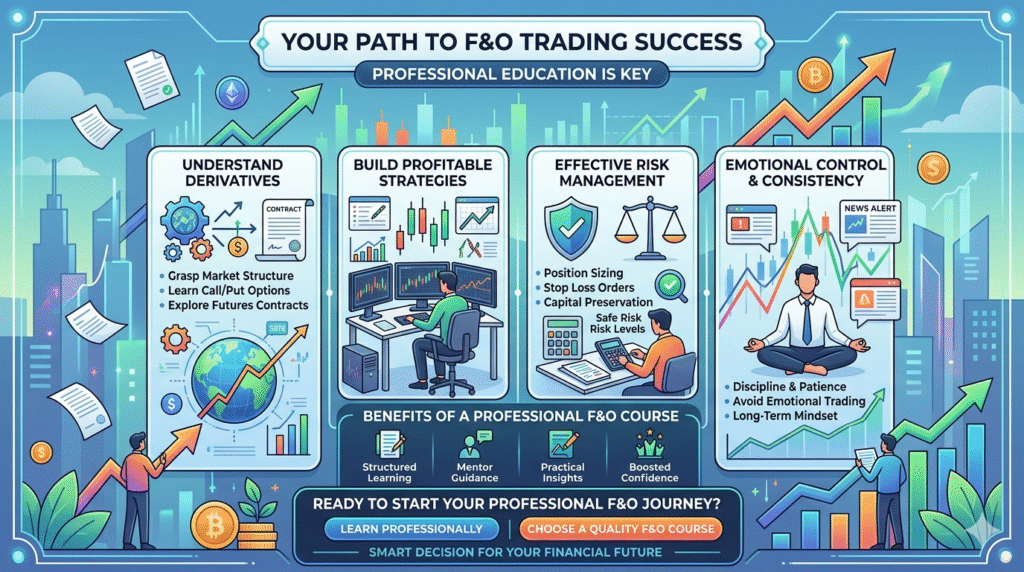
The stock market has become one of the most attractive financial opportunities for people looking to build wealth and generate consistent income. Among all trading segments, Futures and Options trading has gained massive popularity because of its flexibility, leverage opportunities, and profit potential. However, successful trading requires more than just market enthusiasm. Without proper knowledge and strategy, traders often face confusion, emotional decisions, and financial losses. This is why joining a professional F&O trading course has become essential for modern traders. A structured course helps individuals understand market behavior, technical analysis, derivatives, options strategies, risk management, and trading psychology. Whether you are a beginner or an experienced trader, learning from experts can significantly improve your trading performance. If you want to learn f&o trading professionally, choosing the right course can save years of trial and error. The right learning platform provides practical market exposure, live trading sessions, and strategy-based learning that builds confidence and consistency. In this comprehensive guide, we will explore everything about choosing the best f&o trading course, its benefits, learning methods, strategies, and important FAQs for aspiring traders. What is F&O Trading? F&O trading stands for Futures and Options trading, which are derivative contracts based on underlying assets like stocks, indices, commodities, or currencies. Futures Trading A futures contract is an agreement between buyers and sellers to trade an asset at a predetermined price on a future date. Options Trading Options contracts provide traders with the right, but not the obligation, to buy or sell an asset before expiry. There are two types of options: Call Option Put Option A professional F&O trading course teaches traders how to use these derivatives strategically for hedging, speculation, and portfolio management. Why is an F&O Trading Course Important? Many traders enter the market after watching random online videos or social media tips. Unfortunately, this often leads to losses due to lack of proper understanding. A structured F&O trading course provides systematic education that helps traders make informed decisions. Benefits of Professional Learning 1. Understand Market Structure You learn how derivatives work and how institutional traders operate. 2. Learn Technical Analysis Courses teach chart reading, candlestick patterns, indicators, and market trends. 3. Develop Risk Management Skills Risk management helps traders protect capital and survive market volatility. 4. Build Trading Discipline Professional guidance helps traders avoid emotional decisions. 5. Gain Practical Experience Live trading sessions improve confidence in real market situations. When you learn f&o trading from experts, you gain practical knowledge that improves long-term trading consistency. Features of the Best Online F&O Trading Course Choosing the best f&o trading course requires careful evaluation of several important features. Beginner-Friendly Curriculum A good course starts from the basics and gradually moves to advanced concepts. Live Market Sessions Practical market exposure helps traders understand real-time execution. Technical Analysis Training A quality F&O trading course should include: Candlestick analysis Chart patterns Support and resistance Trend analysis Indicators like RSI and MACD Options Strategies The course should cover: Option buying Option selling Spreads Hedging Intraday trading Positional trading Risk Management Risk management is one of the most important aspects of successful trading. Trading Psychology Emotional discipline is critical for maintaining consistency in trading. Lifetime Access Many online courses offer recorded sessions and study materials for future reference. How to Learn F&O Trading Successfully If you want to learn f&o trading professionally, following a structured roadmap is essential. Step 1: Understand Stock Market Basics Learn about: NSE and BSE Stocks and indices Market participants Trading platforms Step 2: Learn Derivatives Concepts Understand: Futures contracts Options contracts Strike price Premium Expiry Open interest Step 3: Study Technical Analysis Technical analysis helps traders identify profitable opportunities. Step 4: Practice Using Demo Accounts Paper trading helps beginners practice strategies without financial risk. Step 5: Build Risk Management Skills Never risk excessive capital on a single trade. Step 6: Learn Strategy Execution A professional F&O trading course teaches proper entry, exit, and stop-loss planning. Step 7: Maintain a Trading Journal Tracking trades helps improve decision-making and consistency. Benefits of Joining an Online F&O Trading Course An online F&O trading course offers several advantages for modern traders. Learn from Anywhere Online classes provide flexibility and convenience. Affordable Learning Compared to offline coaching, online programs are cost-effective. Expert Guidance Students receive mentorship from experienced traders. Practical Learning Live market sessions improve implementation skills. Flexible Timing Working professionals can learn according to their schedule. Structured Education The best f&o trading course follows a systematic learning process. Confidence Building Education reduces fear and confusion during volatile markets. Important Strategies Taught in an F&O Trading Course Professional courses teach multiple strategies for different market conditions. Intraday Trading Traders buy and sell positions within the same trading session. Swing Trading Positions are held for a few days to capture short-term trends. Option Buying Buying call or put options based on market direction. Option Selling Advanced traders use option selling for time decay benefits. Hedging Hedging protects investments from unexpected market movements. Breakout Trading Traders enter positions after prices move beyond key levels. A quality F&O trading course explains how and when to apply these strategies effectively. Skills You Gain from the Best F&O Trading Course The best f&o trading course helps traders develop important financial skills. Market Analysis Understand trends, volatility, and price action. Better Decision-Making Learn strategic trade planning. Capital Preservation Protecting capital becomes easier with proper risk management. Emotional Control Avoid impulsive and fear-based decisions. Strategy Optimization Improve trading systems using market data and analysis. Common Mistakes to Avoid While Learning F&O Trading Many traders lose money because of avoidable mistakes. Trading Without Education Joining a structured F&O trading course reduces beginner errors. Ignoring Risk Management Poor risk management can wipe out trading capital quickly. Following Random Tips Blindly following social media calls is risky. Overtrading Too many trades often increase losses. Emotional Trading Fear and greed negatively affect trading decisions. Unrealistic Expectations Consistent profitability takes time and practice. Who Should Join an F&O Trading Course? A professional F&O trading course is suitable for:

stock trading courses in India
Blog, stock market course

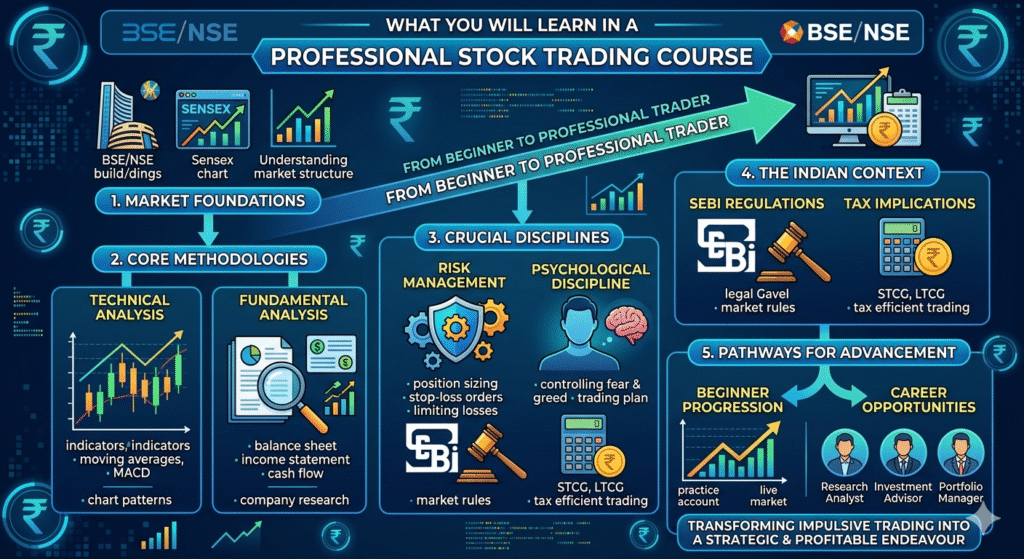
What You Will Learn in a Professional Stock Trading Course

The Indian stock market has never been more accessible. With over 13 crore registered demat accounts and millions of retail investors entering the market each year, the demand to learn stock market trading has surged like never before. Yet, the gap between entering the market and trading profitably remains enormous — and that gap is filled by one thing: structured education. Enrolling in professional stock trading courses can be the single most important investment you make before risking a single rupee in the markets. Whether you are a college student curious about equities, a working professional looking to build a second income stream, or a retiree exploring passive wealth creation, the right course transforms confusion into clarity, impulse trades into calculated decisions, and losses into learning opportunities. This comprehensive guide walks you through everything you will learn in a professional stock trading course — from the foundations of market structure to the nuances of algorithmic trading — and why choosing the right program matters more than most beginners realize. What Are Stock Trading Courses? Stock trading courses are structured educational programs designed to teach individuals how to buy, sell, and manage positions in financial securities including stocks, derivatives, ETFs, and other market instruments. These programs vary widely in scope and depth — from short weekend workshops to multi-month certification programs — but the best ones combine theoretical knowledge with practical application. Unlike self-taught approaches that often rely on fragmented YouTube tutorials or unverified social media tips, professional stock trading courses follow a curated curriculum built around proven trading methodologies, real market scenarios, and mentored practice. They teach you not just what to do, but why a specific strategy works under specific market conditions. At their core, these courses are designed to: Build a deep understanding of how financial markets operate Develop skills in both technical and fundamental analysis Instil disciplined risk management habits Train traders to control emotions during volatile market conditions Prepare learners for certifications like NISM Series VIII or NSE Academy programs Whether delivered in a classroom or online, stock trading courses for beginners and experienced traders alike follow a logic-driven progression that ensures you are never overwhelmed — but always growing. Why Enroll in Stock Trading Courses in India? India’s financial markets — the Bombay Stock Exchange (BSE) and National Stock Exchange (NSE) — rank among the most dynamic in the world. The NSE alone records average daily turnover in excess of ₹20,000 crore in the cash segment. Yet, studies consistently show that 70–90% of retail traders lose money in the long run. The reason is rarely lack of intelligence. It is almost always lack of education. Stock trading courses in India address this critical gap. Here is why they are essential in the Indian context: India-Specific Market Nuances The Indian market operates under SEBI regulations, follows unique circuit breaker rules, and has specific settlement cycles (T+1 rolling settlement). The best stock trading courses in India incorporate these nuances rather than teaching generic global frameworks. Tax Implications Under Indian Law Short-term capital gains (STCG) tax, long-term capital gains (LTCG) tax, Securities Transaction Tax (STT), and GST on brokerage — these are India-specific financial considerations that directly affect your net profitability. Professional courses teach you how to trade tax-efficiently. Access to Indian Indices and Instruments Learning about NIFTY 50, SENSEX, Bank NIFTY, and sectoral indices, along with India-specific instruments like Sovereign Gold Bonds and REITs, is essential for traders operating in this market. Regulatory Awareness SEBI guidelines on margin requirements, insider trading restrictions, and algo trading regulations must be understood by every serious trader. Stock trading courses in India ensure you operate within legal and ethical boundaries. Growing Retail Participation With platforms like Zerodha, Upstox, and Angel One onboarding millions of first-time traders every year, the need for online trading for beginners has never been greater. Education is the foundation of sustainable participation. Core Subjects Covered in Stock Trading Courses A professional stock trading course typically covers the following core subjects in a structured, progressive manner. Understanding these modules helps you evaluate which program gives you the most comprehensive foundation. Understanding Financial Markets and Their Structure Every professional program begins here. Before you place your first trade, you need to understand the ecosystem you are entering. This module covers: How stock exchanges work: Order books, market makers, clearing corporations (NSCCL, ICCL), and settlement processes Types of financial markets: Primary market (IPOs, FPOs) vs. secondary market (exchange-traded equities) Asset classes: Equities, debt instruments, derivatives, commodities, currencies, and mutual funds Market participants: Retail traders, institutional investors, Foreign Institutional Investors (FIIs), Domestic Institutional Investors (DIIs), and High-Frequency Trading (HFT) firms SEBI’s role: Regulatory framework, investor protection mechanisms, and market surveillance Understanding market structure gives you perspective. You realize that every time you click “Buy,” there is a seller on the other side — and understanding who that seller is and why they are selling can mean the difference between profit and loss. Technical Analysis: Reading Charts Like a Pro Technical analysis is the heartbeat of most stock trading courses. It is the art and science of reading price charts to predict future price movements based on historical patterns, volume data, and mathematical indicators. Key topics covered include: Chart Types and Timeframes Candlestick charts, bar charts, and line charts Reading timeframes: 1-minute, 5-minute, 15-minute, hourly, daily, weekly charts Identifying trends: uptrend, downtrend, and sideways consolidation Candlestick Patterns Single candlestick patterns: Doji, Hammer, Shooting Star, Marubozu Multi-candlestick patterns: Engulfing, Morning Star, Evening Star, Harami Reliability ratings and confirmation strategies Support and Resistance Drawing horizontal support and resistance levels Dynamic support/resistance using moving averages Role reversals and breakout confirmation Chart Patterns Continuation patterns: Flags, Pennants, Triangles, Wedges Reversal patterns: Head and Shoulders, Double Top, Double Bottom, Rounding Bottom Volume confirmation for pattern validation Technical Indicators Trend indicators: Moving Averages (SMA, EMA), MACD (Moving Average Convergence Divergence), ADX (Average Directional Index) Momentum oscillators: RSI (Relative Strength Index), Stochastic Oscillator, CCI (Commodity Channel Index) Volume indicators: OBV (On-Balance Volume), VWAP (Volume-Weighted Average Price), MFI (Money

algorithmic trading course
Blog

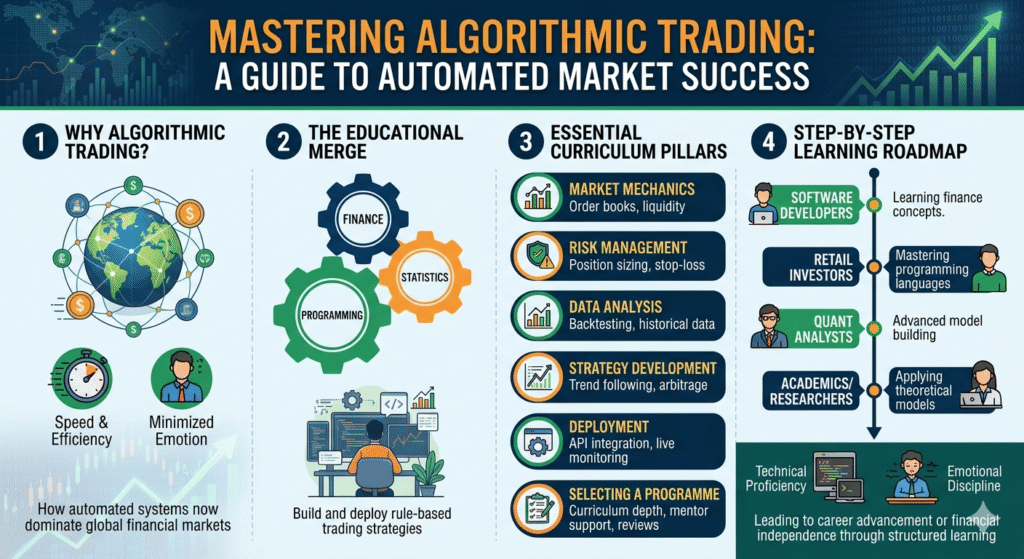
Algorithmic Trading Course Online: How to Get Started Step by Step

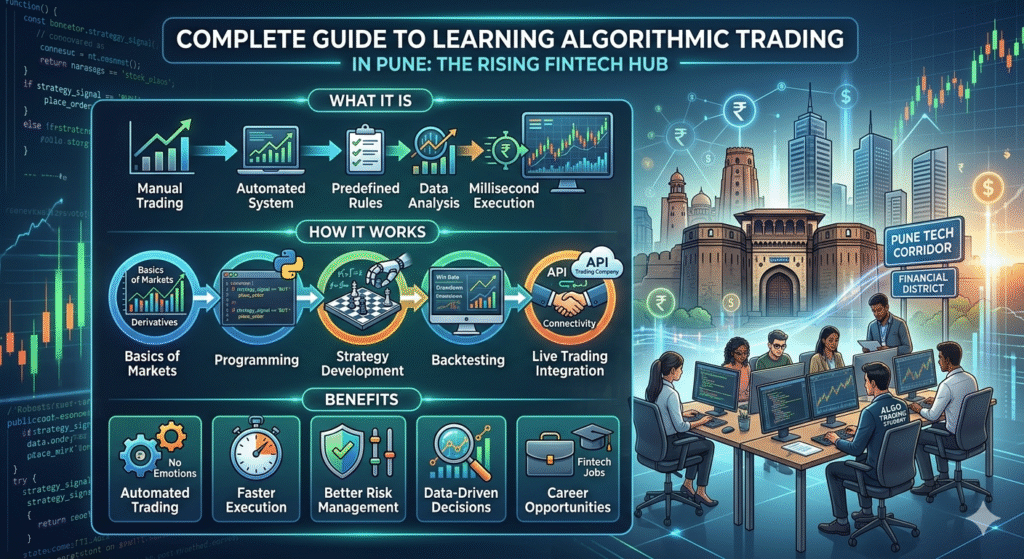
Introduction The financial markets have changed dramatically over the last two decades. Today, more than 70% of all trades executed on major global exchanges are driven by automated systems — not human decisions. This shift has created a massive demand for professionals who understand how these systems work. If you want to enter this world, enrolling in a quality algorithmic trading course is the smartest first step you can take. Whether you are a finance professional looking to upgrade your skills, a programmer who wants to break into trading, or a complete beginner curious about the markets, an algorithmic trading course online gives you the flexibility to learn at your own pace, from anywhere in the world. You get structured learning, real-world projects, and access to industry-standard tools — all without leaving your desk. This comprehensive guide walks you through everything you need to know: what an algorithmic trading course covers, how to choose the right one, a clear step-by-step process to get started, the core benefits, and answers to the most frequently asked questions. By the end, you will know exactly how to move forward with confidence. What Is an Algorithmic Trading Course? Defining Algorithmic Trading Algorithmic trading — also called algo trading, automated trading, or black-box trading — refers to the use of computer programs and defined rule-based systems to place trades in financial markets. These algorithms analyze market data, detect signals, and execute buy or sell orders faster and more accurately than any human trader could manage manually. An algorithmic trading course teaches you how to design, build, test, and deploy these systems. It covers the mathematical models, programming logic, risk management frameworks, and data analytics techniques required to create trading strategies that perform consistently across varying market conditions. What Makes It Different from Traditional Trading Education? Traditional trading education focuses on manual analysis — reading charts, interpreting news, and placing trades based on intuition or pattern recognition. An algorithmic trading course goes much further. It blends finance theory with data science, statistics, and computer programming. You learn to code trading strategies, backtest them against historical data, and run them in live or simulated markets. This combination of disciplines makes an algorithmic trading course uniquely valuable in today’s data-driven financial environment. Firms of all sizes — from global investment banks to independent hedge funds — rely on algorithmic systems to gain a competitive edge. Core Areas Covered A well-designed algorithmic trading course typically covers: Market microstructure — how exchanges work and how orders are matched Statistical analysis — using data to identify patterns and opportunities Strategy development — building rule-based systems from scratch Backtesting — simulating strategies on historical data before going live Risk management — controlling drawdowns and position sizing Programming — writing code in Python, R, or C++ for automation Live deployment — connecting strategies to real brokerages Each of these pillars is essential to becoming a competent algorithmic trader. Why Take an Algorithmic Trading Course Online? Flexibility Without Compromise An algorithmic trading course online removes the barriers of geography and rigid schedules. You can study from Mumbai, London, New York, or anywhere with an internet connection. Most platforms offer lifetime access to recorded lectures, so you can revisit complex concepts as many times as needed. This flexibility is critical for learners who are working full-time or balancing other responsibilities. Unlike campus-based programs, an algorithmic trading course online allows you to move at a pace that works for your lifestyle. Access to World-Class Instructors Many of the best algorithmic trading course providers feature instructors who have hands-on experience managing hedge funds, quantitative desks at major banks, or proprietary trading firms. When you choose an algorithmic trading course online, you often gain access to expertise that would be unavailable in your local academic environment. Cost-Effective Learning Compared to a university degree in quantitative finance, an algorithmic trading course online is significantly more affordable. Many platforms offer payment plans, group discounts, or free introductory modules so you can sample the content before committing financially. Community and Networking Leading algorithmic trading course platforms host active student communities — Discord servers, Slack groups, forums, and live Q&A sessions with mentors. These communities are invaluable for getting feedback on your code, debugging strategies, and connecting with peers who share your goals. Who Should Enroll in an Algorithmic Trading Course? An algorithmic trading course is not reserved for Wall Street professionals or seasoned coders. Here is a breakdown of who benefits most: Finance professionals who want to transition from manual trading to systematic, data-driven approaches will find an algorithmic trading course directly applicable to their existing knowledge base. Software developers and data scientists looking to apply their programming skills in financial markets will discover that an algorithmic trading course gives them the domain-specific finance knowledge they need to bridge the gap. Students studying mathematics, statistics, economics, or computer science gain a significant career advantage by adding algorithmic trading skills before entering the job market. Retail investors and individual traders who want to remove emotion from their trading decisions and replace gut-feel decisions with systematic, testable strategies will find great value in a quality algorithmic trading course. Entrepreneurs and fintech founders building financial products or robo-advisory services will find the knowledge from an algorithmic trading course foundational to their product development journey. If you fall into any of these categories, there is an algorithmic trading course online designed specifically for your background and goals. How to Choose the Best Algorithmic Trading Course  With dozens of options available, selecting the best algorithmic trading course for your needs requires careful evaluation. Here are the key factors to consider: 1. Curriculum Depth and Structure Review the syllabus before enrolling. The best algorithmic trading course should have a logical progression — starting with foundational concepts like market mechanics and basic statistics, then building toward advanced topics like machine learning-based trading models and high-frequency trading infrastructure. Look for a course that covers strategy development, backtesting, and live deployment — not just theory. An algorithmic trading course

stock trading courses
Trading Course

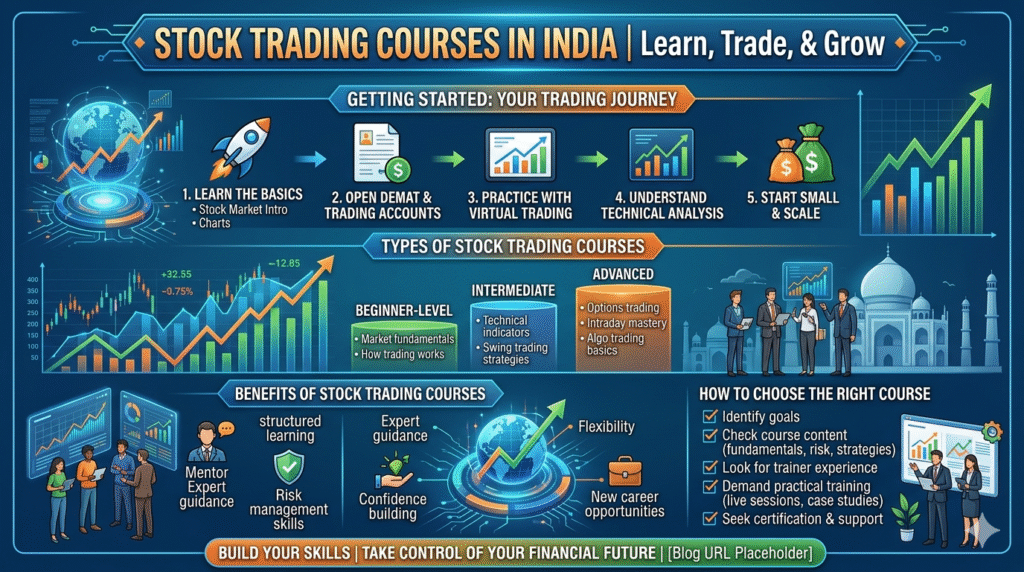
Stock Trading Courses in India: Learn, Trade, and Grow

Introduction In today’s fast-paced financial world, mastering the art of trading is no longer optional—it’s essential. With increasing participation in equity markets, more individuals are actively seeking stock trading courses to build sustainable income streams and financial independence. Whether you’re a student, working professional, or entrepreneur, enrolling in structured stock trading courses can significantly improve your understanding of market dynamics. This blog will guide you through everything you need to know—from how to start, benefits, and course selection tips to frequently asked questions. About Stock Trading Courses Stock trading courses are structured learning programs designed to teach individuals how to buy and sell stocks strategically. These courses cover a wide range of topics, including technical analysis, fundamental analysis, risk management, and trading psychology. With the rise of digital education, you can now learn stock market trading from the comfort of your home. Many platforms offer online trading for beginners, making it easier than ever to get started. Types of Stock Trading Courses Beginner-Level Courses Ideal for those new to the market. These include basics like: What is the stock market? How trading works Introduction to charts Intermediate Courses Focus on: Technical indicators Swing trading strategies Market trends Advanced Courses Include: Options trading Intraday trading mastery Algorithmic trading basics If you’re searching for stock trading courses near me, ensure the institute offers both theoretical and practical exposure. How to Choose the Right Stock Trading Course Choosing the right course can make or break your trading journey. Here’s a step-by-step guide: 1. Identify Your Goals Are you looking for passive investing or active trading? Your goals will determine which stock trading courses suit you best. 2. Check Course Content Ensure the course covers: Market fundamentals Risk management Trading strategies The best online stock trading courses in India provide comprehensive modules along with real-time examples. 3. Trainer Experience Look for mentors with real trading experience. This is crucial when selecting stock trading courses for beginners. 4. Practical Training Theory alone isn’t enough. Choose courses that offer: Live trading sessions Case studies Assignments 5. Certification & Support Top stock trading courses in India offer certifications and post-course support. How to Start Learning Stock Market Trading If you’re wondering how to begin your journey, follow these steps: Step 1: Learn the Basics Start with online trading for beginners courses that explain: Market terminology Types of stocks Trading platforms Step 2: Open a Demat Account To trade in India, you need: Demat account Trading account Step 3: Practice with Virtual Trading Before investing real money, use simulators to learn stock market trading effectively. Step 4: Understand Technical Analysis Charts, indicators, and patterns are crucial in all stock trading courses. Step 5: Start Small Begin with small investments and gradually scale up. Benefits of Stock Trading Courses Enrolling in stock trading courses offers numerous advantages: 1. Structured Learning Unlike random YouTube videos, professional courses provide step-by-step learning. 2. Expert Guidance You get insights from professionals who understand market behavior. 3. Risk Management Skills Good stock trading courses for beginners emphasize capital protection. 4. Confidence Building Knowledge reduces fear and emotional decision-making. 5. Career Opportunities After completing best online stock trading courses for beginners, you can: Become a trader Work in financial firms Start advisory services 6. Flexibility With online trading for beginners, you can learn anytime, anywhere. Why Choose Online Trading Courses The demand for best online stock trading courses in India has grown significantly due to: Convenience Affordable pricing Access to expert trainers Updated content Many learners prefer online formats over searching for stock trading courses near me due to flexibility and cost-effectiveness. Key Features of the Best Stock Trading Courses When evaluating stock trading courses, look for: Live market training Real-time trading examples Mentorship programs Community access Updated curriculum The best online stock trading courses for beginners combine theory with hands-on practice. Common Mistakes Beginners Make Even after enrolling in stock trading courses, beginners often: Ignore risk management Overtrade Follow tips blindly Lack discipline Skip practice sessions A good course will help you avoid these pitfalls while you learn stock market trading effectively. Stock Trading vs Investing Many people confuse trading with investing. Here’s the difference: Trading Investing Short-term Long-term Frequent buying/selling Buy & hold Technical analysis Fundamental analysis Most stock trading courses in India cover both approaches to give you a holistic understanding. Who Should Take Stock Trading Courses These courses are ideal for: Students Working professionals Business owners Housewives Retired individuals Whether you’re searching for stock trading courses near me or online options, there’s something for everyone. Future of Stock Trading in India India’s stock market participation is growing rapidly. With increased digital access, more individuals are enrolling in best online stock trading courses in India. The future looks promising with: More retail investors Advanced trading tools AI-based strategies Conclusion The journey to becoming a successful trader begins with the right education. Investing in high-quality stock trading courses can accelerate your learning curve, minimize risks, and improve profitability. Whether you choose classroom training or best online stock trading courses in India, the key is consistency and discipline. Start today, build your skills, and take control of your financial future. FAQs 1. What are stock trading courses? Stock trading courses are educational programs that teach how to trade stocks profitably using strategies and analysis. 2. Can beginners learn trading online? Yes, many platforms offer online trading for beginners, making it easy to start from scratch. 3. How long does it take to learn stock trading? It depends on the course. Most stock trading courses for beginners take 1–3 months. 4. Are online courses better than offline? The best online stock trading courses for beginners offer flexibility, affordability, and updated content compared to offline options. 5. What is the cost of stock trading courses in India? Costs vary widely. Many stock trading courses in India range from ₹5,000 to ₹50,000 depending on depth and mentorship. 6. Do I need prior knowledge? No, stock trading courses for beginners start from the basics. 7. Can I

best stock market course
Blog

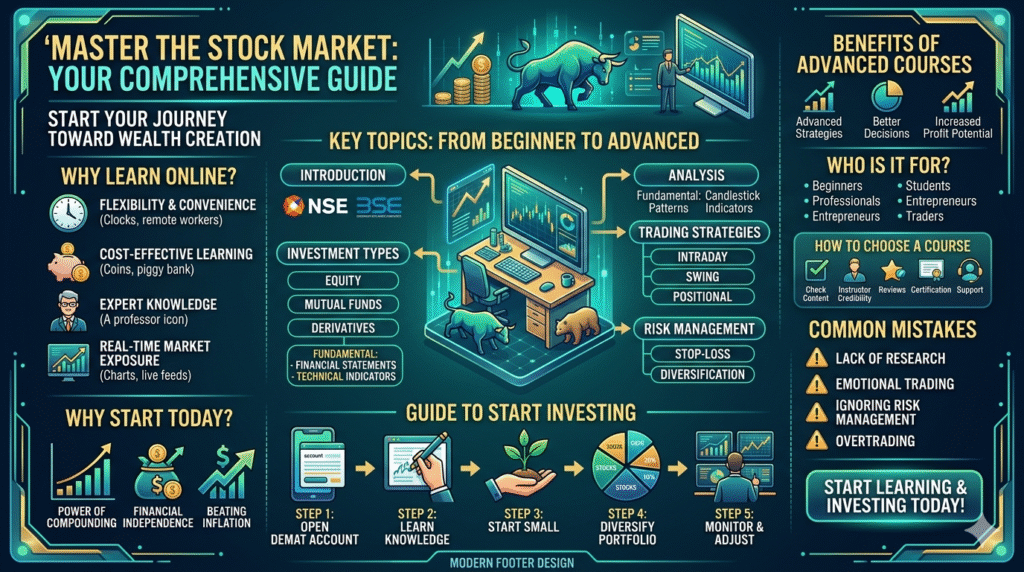
Best Stock Market Course Online – Start Investing Today

Introduction In today’s fast-paced digital economy, investing in the stock market is no longer reserved for financial experts. With the right knowledge and guidance, anyone can begin their journey toward wealth creation. That’s where enrolling in the best stock market course becomes essential. Whether you’re a beginner looking to understand the basics or an aspiring trader seeking advanced strategies, choosing the right stock market course can make all the difference. This guide will help you understand why online learning is the best approach and how a well-structured advance stock trading course can empower you to make smarter investment decisions. Why Learn Stock Market Investing Online? The rise of online education has transformed how people learn finance and investing. Here are a few reasons why an online stock market course is the best option: 1. Flexibility and Convenience Online courses allow you to learn at your own pace. Whether you’re a student, working professional, or entrepreneur, you can fit learning into your schedule. 2. Cost-Effective Learning Compared to traditional classroom training, online courses are often more affordable while offering high-quality content. 3. Access to Expert Knowledge Top instructors and industry professionals provide insights that are practical and actionable. 4. Real-Time Market Exposure Many courses include live trading sessions, case studies, and real market analysis. What Makes the Best Stock Market Course? Not all courses are created equal. The best stock market course should include: Comprehensive Curriculum A complete course should cover: Basics of stock market Technical analysis Fundamental analysis Risk management Trading psychology Beginner to Advanced Learning Path A structured course that evolves from beginner concepts to an advance stock trading course ensures long-term growth. Practical Training Hands-on experience through simulations or live trading sessions is crucial. Updated Content Markets change constantly, so your course should stay updated with current trends. Key Topics Covered in a Complete Course on Indian Stock Market A complete course on Indian stock market should provide in-depth knowledge of the Indian financial ecosystem. 1. Introduction to Indian Stock Market Understanding NSE & BSE How stock exchanges work Market participants 2. Types of Investments Equity shares Mutual funds Derivatives IPOs 3. Fundamental Analysis Reading financial statements Evaluating company performance Ratio analysis 4. Technical Analysis Candlestick patterns Chart analysis Indicators like RSI, MACD 5. Trading Strategies Intraday trading Swing trading Positional trading 6. Risk Management Stop-loss strategies Portfolio diversification Capital allocation Benefits of Enrolling in an Advance Stock Trading Course If you already understand the basics, an advance stock trading course can take your skills to the next level. Advanced Strategies Learn high-level trading techniques such as: Options trading strategies Futures trading Algorithmic trading basics Better Decision-Making Develop the ability to analyze markets quickly and accurately. Increased Profit Potential With the right strategies, you can improve your risk-reward ratio. Professional Growth Advanced knowledge opens doors to careers in finance, trading, and investment advisory. Who Should Take a Stock Market Course? A stock market course is suitable for: Beginners with no prior knowledge Students interested in finance Working professionals seeking extra income Entrepreneurs wanting to manage investments Traders aiming to upgrade their skills How to Choose the Best Stock Market Course Online? Selecting the right course is crucial. Here are some tips: Check Course Content Ensure it covers both basics and advanced topics. Instructor Credibility Look for experienced professionals with proven track records. Reviews and Testimonials Feedback from previous students can give valuable insights. Certification A certificate adds credibility to your learning. Support and Community Courses with mentorship and community support enhance learning. Common Mistakes Beginners Make in Stock Market Even with the best course, beginners often make mistakes: Lack of Research Investing without proper analysis can lead to losses. Emotional Trading Fear and greed often result in poor decisions. Ignoring Risk Management Not using stop-loss can wipe out capital. Overtrading Frequent trades without strategy reduce profits. Why Start Investing Today? The earlier you start investing, the greater your potential returns due to compounding. Power of Compounding Even small investments grow significantly over time. Financial Independence Investing helps you build long-term wealth. Beating Inflation Stock market returns often outperform inflation. Step-by-Step Guide to Start Investing After completing your stock market course, follow these steps: Step 1: Open a Demat Account Choose a reliable broker. Step 2: Learn Market Basics Apply knowledge gained from your course. Step 3: Start Small Begin with small investments. Step 4: Diversify Portfolio Avoid putting all money in one stock. Step 5: Monitor and Adjust Keep track of your investments regularly. Future of Stock Market Learning The demand for financial literacy is increasing rapidly. Online learning platforms are integrating: AI-based trading tools Interactive learning modules Real-time simulations This makes enrolling in the best stock market course more valuable than ever. Frequently Asked Questions 1. What is the best stock market course online for beginners? The best stock market course online for beginners is one that covers basics like stock market fundamentals, technical analysis, and risk management. Platforms like API Trader provide beginner-friendly training along with practical exposure to live markets. 2. Is an online stock market course worth it? Yes, an online stock market course is worth it if it provides practical knowledge, live trading sessions, and mentorship. It helps beginners avoid common mistakes and learn structured investing strategies. 3. Can I learn stock market trading online from home? Yes, you can easily learn stock market trading online from home. Many courses offer recorded sessions, live classes, and real-time trading practice that you can access anytime. 4. How long does it take to learn stock trading? Learning stock trading basics can take a few weeks, but mastering it may take months or years depending on your practice, discipline, and market experience. 5. Do I need prior knowledge to join a stock market course? No, most stock market courses are designed for beginners. You can start learning without any prior knowledge of trading or investing.

stock market india
Blog

Stock Market India: Complete Beginner Guide (2026)

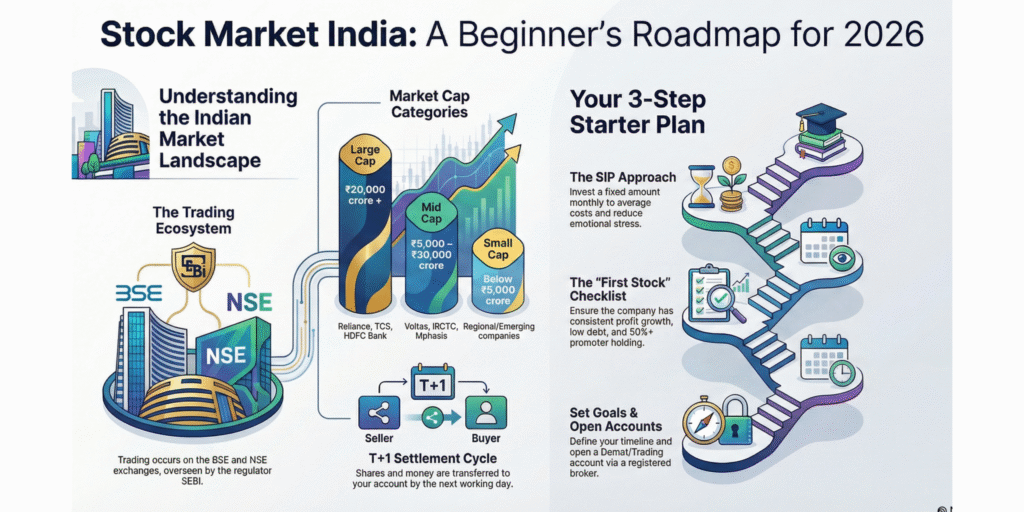
Introduction If you have ever wondered how people grow their money by simply buying and selling shares on a screen — you are in the right place. The stock market India ecosystem has never been more accessible to everyday investors. With smartphones, zero-brokerage apps, and a wealth of free information, anyone can start investing today. But where do you actually begin? This complete beginner’s guide to the stock market in India for 2026 will walk you through everything — from what the stock market india is and how it works, to the different types of stocks, key terms, and your very first steps as an investor. Whether you are a student, a working professional, or a homemaker looking to make your savings work harder, this guide is built for you. Let us start from the very beginning. What Is the Stock Market and How It Works Defining the Stock Market The stock market india is a marketplace where buyers and sellers come together to trade shares (also called stocks) of publicly listed companies. When a company wants to raise money from the public, it lists itself on a stock exchange and offers shares to investors. When you buy a share, you become a partial owner of that company. In simple terms — if you own 100 shares of a company that has issued 1,00,000 shares in total, you own 0.1% of that company. How Does the Stock Market Work? Here is a step-by-step breakdown of what is stock market india and how it works: Company lists on an exchange — A company goes through an Initial Public Offering (IPO) to list its shares on the Bombay Stock Exchange (BSE) or the National Stock Exchange (NSE). Shares are issued to the public — Investors apply for shares during the IPO at a fixed price. Trading begins — After listing, shares are freely bought and sold between investors on the exchange. Price moves with demand and supply — If more people want to buy a stock than sell it, the price goes up. If more people want to sell, the price falls. Investors earn returns — You can earn through price appreciation (selling shares at a higher price than you paid) or dividends (a share of the company’s profit paid to shareholders). The entire process is regulated by the Securities and Exchange Board of India (SEBI), which protects investors and ensures fair markets. Why Does the Stock Market Exist? The stock market india serves two critical purposes: For companies: It provides access to capital for expansion, research, and operations without taking loans. For investors: It provides an opportunity to participate in the growth of businesses and build long-term wealth. Stock Market Basics Every Beginner Must Know Before you invest a single rupee, you need to understand the foundational stock market basics. These concepts will come up every day as an investor, so take your time here. Shares and Equity A share represents a unit of ownership in a company. When you hold shares, you hold equity in that business. This means you have a claim on the company’s assets and profits proportional to your shareholding. Market Capitalisation Market capitalisation (or market cap) is the total market value of a company’s outstanding shares. It is calculated as: Market Cap = Share Price × Total Number of Shares Companies are broadly classified based on market cap: Category Market Cap Examples Large Cap ₹20,000 crore and above Reliance, TCS, HDFC Bank Mid Cap ₹5,000 – ₹20,000 crore Voltas, IRCTC, Mphasis Small Cap Below ₹5,000 crore Smaller regional companies Bull Market vs Bear Market A bull market is when stock prices are rising consistently — investor confidence is high. A bear market is when stock prices are falling — economic pessimism sets in. As a beginner, remember: both are normal. Markets move in cycles. Patience is your most powerful investment tool. Index: Sensex and Nifty You will often hear the words “Sensex” and “Nifty” on financial news. These are market indices — they track the performance of a group of top-performing stocks to give you a snapshot of how the overall market is doing. Sensex (BSE Sensex): Tracks the top 30 companies on the Bombay Stock Exchange. Nifty 50 (NSE Nifty): Tracks the top 50 companies on the National Stock Exchange. When the Sensex rises, it generally means the market is performing well. When it falls, sentiment is negative. Dividends A dividend is a portion of a company’s profits distributed to shareholders. Not all companies pay dividends — growth companies often reinvest their profits instead. However, many large, stable companies (called blue-chip stocks) regularly pay dividends to shareholders. How the Stock Market Works in India {#how-stock-market-works-india} The Role of SEBI The Securities and Exchange Board of India (SEBI) is the apex regulator of the Indian securities market. Established in 1992, SEBI’s job is to: Protect the interests of investors Regulate and develop the securities market Prevent fraudulent and unfair trade practices Every broker, exchange, and mutual fund in India must comply with SEBI’s rules. As an investor, this gives you a strong layer of protection. How a Trade Actually Happens When you place a buy order for a stock through your trading app, here is what happens behind the scenes: Your order goes to your broker’s system. The broker routes it to the stock exchange (BSE or NSE). The exchange matches your buy order with a matching sell order. The trade is executed and confirmed within milliseconds. Settlement happens in T+1 days — meaning shares and money are transferred to/from your Demat account the next working day. This entire process, from your tap to confirmation, happens almost instantly. Market Timings in India Indian stock markets operate Monday to Friday (excluding public holidays): Pre-opening session: 9:00 AM – 9:15 AM Regular trading session: 9:15 AM – 3:30 PM Post-closing session: 3:40 PM – 4:00 PM Different Types of Stocks in India {#different-types-of-stocks} Understanding the different types of stocks is one of the most important pieces of